
A Review of Remarkably Bright Creatures for parents of estranged children.
Not since David Ogden Stiers invited us to meet the Beast have I enjoyed an opening movie monologue more than Alfred Molina’s disdain for third graders as Marcellus in the opening seconds of Remarkably Bright Creatures. Molina provided his voiceover without credit in this “remarkable” movie streaming on Netflix.
The film is based on Shelby Van Pelt’s debut novel of the same name. It spent more than a hundred weeks on the New York Times bestseller list, but somehow I missed it. The story glides along the coast of Washington State with the ease of an early Sunday morning paddleboarder. Nestled in the middle of town rests a small aquarium where we meet Tova, Cameron, and of course, Marcellus.
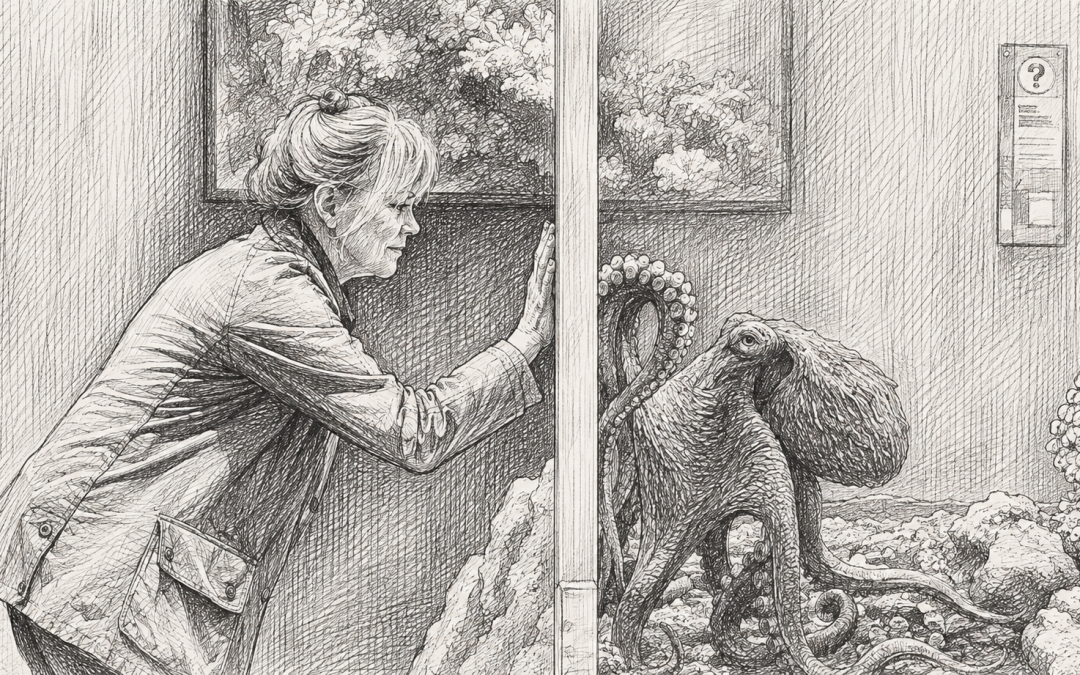
Sally Field plays Tova Sullivan, a seventy-year-old widow who lost her son to a tragic accident decades ago and her husband to illness in their retirement years. She works as the aquarium’s night janitor, scraping gum from the floor and removing finger- and tongue-prints from the windows of the displays.
In her solitude, she processes her feelings and the events of her days out loud with Marcellus, the aquarium’s star attraction, an aging giant Pacific octopus. His wise and self-important observations of humanity bring as many thoughtful nods as his humor brings laughs. He was injured by a wolf eel, or else a fisherman never would have snagged him and sentenced him to his glass prison.
Cameron, played by Lewis Pullman, rounds out our trio of wounded souls. He rumbles into town in the van his mother died in, carrying a ring that belonged to his unknown biological father and a chip on his shoulder almost as big as the hole in his heart.
I couldn’t help but watch this beautifully shot and delightfully written movie without seeing myself in its characters. Of course, that’s the power of a good story—we find ourselves in its pages or its frames. The movie is a study in grief—where it comes from, how it hangs on, where it surprises us, and what is required to keep living despite it. Grief is the cord that binds them all together, tighter than the extension cord Marcellus found himself wrapped in. For estranged parents, the film offers a chance to look at three aspects of our particular grief.
In one of the earliest lines in the movie, Marcellus observes about Tova, “We both dream of the bottom of the sea and what we lost there.”
Tova lost her son prematurely and is still walking through grief while also mourning the loss of her husband. She has not entered her son’s room in thirty years. She has preserved it exactly as it was. She can’t go in there. And bristles when others do. We recognize the impulse, don’t we? We are sometimes stuck in our grief, stuck remembering our children as they were when we were last connected. That is easy to do, because those are the photographs we see on our phones, our walls, or in the yellowing albums on our shelves. But time has passed. Which has changed more? Hairstyles and clothing choices, or the ways our estranged children—our beloved strangers—have grown, learned, and adapted to their worlds without us present? By the end of the film, Tova enters the room. That gives us hope that we, too, may one day be ready to move forward in our grief rather than preserve it like a room no one is allowed to enter.
Cameron never knew his father’s identity and barely knew his mother. When his mother died, he found the truth among her things. Pullman adroitly performs anger, disappointment, loss, longing, hope, and curiosity at once with the skill of a guitar virtuoso, which he is not. He wants to say things he has never been allowed to. He wants to receive something he feels he is owed. For us, the speck-and-plank principle is worth sitting with here: what might our beloved strangers need to say to us? And if we know—or even suspect—what those words might be, are we prepared to respond? Not defensively, but in a loving way that gives them the gift they need?
Marcellus grieves the loss of his rightful home. He dreams about the cave at the bottom of the sea, where he could look out and see the marvels of creation, experience God’s provision, and know the proper life and death of an octopus. Estrangement has disrupted our lives in a similar way. It changed not only the great days on the calendar, like birthdays and Christmas, but every ordinary day, every interaction with someone who innocently asks about our children, and every moment we wonder what others are saying about our parenting when we are not around. We are not in our natural habitat. We, like Marcellus, feel hopeless about getting back there. And like him, we sometimes make foolish decisions to force the issue.
The first time I watched the movie, I missed a key scene. Tova is trying to track down information about the year her son died, and wonders if one of her friends, one of the “Knit-Wits,” has the answer. I saw this scene as part of the rising action, but missed the wisdom of her friend. Tova apologizes for the umpteenth time and tries to leave Mary Ann (played by Kathy Baker who always seems to get great lines) alone. Mary Ann says,
“Will you stop?! You are not a burden. Tova, you’re my friend. This is what we do for each other. Do you know that I’m still not used to sleeping upstairs all by myself in that big bed? I keep to my side and every morning I wake up surprised that I’m alone. And now I have to leave my best friends and move to a city where I don’t know anybody but my grandchildren. I’m scared. I’m scared, Tova, and I really wish I could talk about this with you, but you are soooo busy trying not to be a burden to anyone that you’ve forgotten how to be a friend. I mean, what’s the point? What’s the point if you stop the business of living?”
Our lives didn’t end when our children went “no contact.” Yes, they changed. Yes, it hurts. Yes, in some ways, we feel frozen in time. But the days move on. We count them like Marcellus counted every day in the tank. And we, too, must not stop the business of living. We must walk, even with a limp, with our friends, so we can keep hope alive. Maybe, if we open our hearts and our stories to others, Marcellus might call us remarkably bright creatures, too.
What aspects of grief do you struggle with the most? Share your story in the comments.