
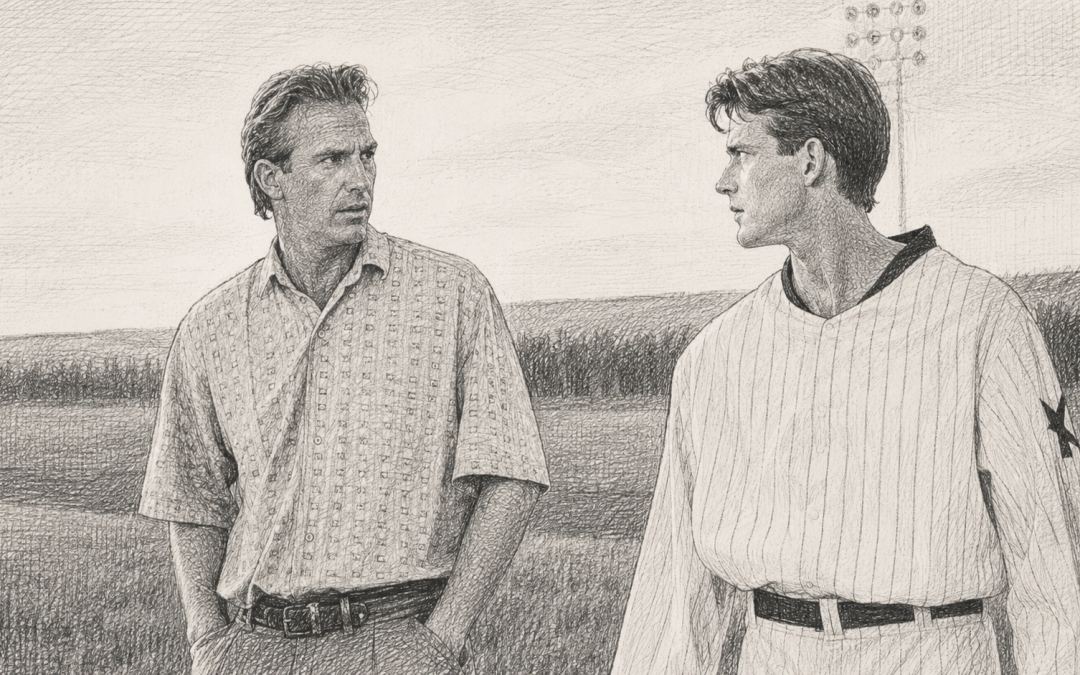
A Deep Dive into Field of Dreams, estranged fathers, and movie magic
Field of Dreams will endure as one of the greatest baseball movies of all time. James Earl Jones delivers one of his most iconic performances. The lines from the movie will echo in dugouts and around dinner tables for generations. But at the heart of the movie lies the story of an estranged father and son.
Movie makers often compress decades of information into an exposition scene so that they can get all the history out of the way of the story that’s about to unfold. Field of Dreams does so when it presents the life story of Ray and Annie Kinsella through a slide show with a Kevin Costner voiceover. Tucked inside this outstanding two-minute and five-second monologue is this telling line:
Dad was a Yankees fan then, so of course I rooted for Brooklyn. But in ‘58 the Dodgers moved away, so we had to find other things to fight about.
Baseball evolved into the sword that cut the knot of their father/child relationship. The refrain of this problem comes back again and again to set up the glorious three-hankie final scene. Baseball also brings together Ray’s relationship with his elementary-aged daughter, Karin. Ray’s eyes light up as he shares stories and stats, defines terminology, and introduces his daughter to the sport. Watch how often she is the one moving the movie forward. She rides on the tractor with Ray as he plows under his corn like a horse’s ass. She interrupts a budget conversation with the news that there’s a man out there on his lawn. She pulls Ray from the lunch with the in-laws. The “People will Come” speech is not James Earl Jones’. No, it is Karin’s. Jones just continues it. And of course, Karin’s choking episode opens the eyes of ole Uncle Mark who wants to foreclose on the farm with his ruthless partners.
Yes, baseball drove Ray and his father, John, apart as much as it brought Ray and his daughter, Karin, together. Take for instance the other exposition dump in the movie. Archibald “Moonlight” Graham is asleep in the back of the VW Bus while Ray and Terrance Mann talk about baseball between the World Wars. Terrance pushes Ray to talk more about his dad. This scene plays out:
Have you ever heard someone talk about “The Field of Dreams Myth”? In business parlance, if a company founder or solopreneur thinks, “If I build it, customers will come,” they’ve bought into the myth. In the same way, I think we estranged parents have a “Field of Dreams Myth” about our children. We watch the relationship between Ray and Karin and nostalgia causes goosebumps to spring up on our arms and our tear ducts to shift into overdrive. We comment to ourselves, “I was like that. I was involved. I was spirited, and playful, and invited my children into my life.”
When Ray says, “So when I was fourteen, I started to refuse. Can you believe that? An American boy refusing to have a catch with his father?” we mumble in reply.
“You see? Those petty arguments during adolescence. Of course. My son was trying to grow wings. I was worried about missing him when he left. I wanted to squeeze every lesson I possibly could into those final few years, but he just wouldn’t listen.”
Next, we hear Ray say, “We had a big fight, I packed my things, said something awful, and left. After a while I wanted to come home, but I didn’t know how. I made it back for the funeral“ (emphasis mine).
The “Field of Dreams Myth” is now firing off rockets in our souls. “You see! There’s regret! There’s sorrow! Oh, he just didn’t know how. Maybe I should reach out right now. I don’t want my son to live out my greatest nightmare: only making it back for the funeral.”
One story told by some of America’s greatest actors, scored by James Horner (Titanic, Brave Heart, Apollo XIII), wrapped up in what used to be America’s greatest pastime does not equal a formula for reconciliation from estrangement.
So, can we learn anything about our children, our pain, or life in general from the movie?
Perhaps. Allow me to spell out three observations I made during my most recent celluloid (or I guess I should say digital) trip to Iowa.
1. Annie is the Key
Annie, played by Amy Madigan, has never met John, her father-in-law. He’s been dead for many years. Her story doesn’t apply to all or ours. She wasn’t hurt by and never argued with John. She could tell her husband to forget about his dad, rehearse all of the pain Ray shared with her (which if not everything would’ve triggered Ray to remember the rest), and talk about the future or moving on. Instead, she encourages the dream and shares it with her husband.
If our estranged children are married, we cannot escape the role our children’s spouses play in reconciliation. And here’s the awful part: we can’t change the spouse’s opinion one iota. Some may claim they “know” the spouse is the one who pulled the beloved stranger away. Let us check ourselves if we believe that. Others among us may say, “I had a good relationship with him/her early in the relationship, I should give him/her a call to try and end this silliness.” Friends, may we stop before we pick up the phone and pose our thumbs over the buttons.
In the same way that Annie turns the field lights on so Ray and John can continue their game of catch, your beloved stranger’s spouse may be the one to turn the light on. Or it may just be that he/she doesn’t turn it off. Pray for understanding, wisdom, and empathy for yourself. And pray for him/her, too, because he/she is carrying a burden as well.
2. Terrance Mann Called His Father
While in Chisholm, Minnesota, Ray picks up a copy of the newspaper and reads a story reporting that Terrance Mann is considered missing. Mann’s father had notified police after he couldn’t reach his son on the phone. In one of the biggest laugh lines, Ray leaves the motel room to give Mann some privacy, Terry picks up the phone and then freezes. He says to the room, “What do I tell him?”
Ray was driven apart from his dad by several factors including continued grief from the loss of his mother, “The Sixties,” arguments, rugged insistence on baseball leading to burnout, and reading The Boat Rocker by Terrance Mann. We don’t know anything else. The movie doesn’t tell us. In the same way that you haven’t disclosed every moment of every encounter with your children, your beloved stranger has probably not disclosed every encounter with others or especially you. Besides, none of us can know which moments are the defining ones.
Mann is still connected to (or possibly reconnected to; we don’t know) his father. So, one of the architects of “The Sixties” and the author of Ray’s wedge is not estranged from his father. Sure, it’s a “Greatest Generation” dad and a “Silent Generation” son in the Manns’ case as opposed to a “Silent Generation” father and a “Boomer” son in the case of the Kinsellas. But it is much deeper than that. We don’t know what kept the Manns together. Nor do we know exactly what keeps some families from estrangement. Why do we compare? Why do we say, “Well, look at them? My child and their child practically grew up together. How many movies and sleepovers and birthday parties and school basketball games did we all attend together? What did they do that I didn’t?” Every parent/child story is as different as every pitcher’s curve ball. So, just rest in the fact that God knows your exact situation and is working it out according to His will and His timing.]
3. John and Ray Meet Again Surrounded by Understanding
Close your eyes and think for just a moment about where John and Ray are emotionally when they shake hands. Okay, you can open them again. John, dead for many years, has come back to a magical place where he is playing baseball with some of the greatest athletes in the history of the sport. A minor league catcher who never got called up, I wonder if he’s seeing the gap between his skill set and that of the other players. He’s had decades, in the universe of the movie, to reflect on his life. He appears grateful. Grateful for the field to return to, grateful for the chance to play, and grateful to meet Annie and Karin. He expresses his gratitude through the handshake.
Ray has been on an odd journey for longer than a year. He destroys his crop, he builds a field no one understands, he endures months with no movement, his financial world is upside down dangling above the shredder, he was faced with whether or not to give it all up to end the pain, his daughter could’ve died, and in that very moment, he feels like he did it all for nothing because he can’t go with the players into the corn. He shakes his father’s hand amid pain and uncertainty.
You’re ahead of me, aren’t you? You’re already saying, “Exactly! So how do I get to this level of understanding with my son/daughter?”
Where Do Estranged Parents Go from Here?
Who is the driving force behind Ray and John’s story? We know better than to say, “The Universe.” We know it is God Almighty. In a series of beautiful and memorable moments made for Hollywood, director Phil Alden Robinson (Sneakers, The Sum of All Fears) sews up this tale in exactly 100 minutes.
God, the author and perfecter of our stories, is certainly taking longer than 100 minutes with your story and mine. But let us take heart, dear friend. Allow me to close with words from another amazing storyteller, Frank Peretti:
God is the grand storyteller of our lives. He weaves our days and then strings them like beads on the chain of history. He knows the placement of every person and event, the end from the beginning. From His lofty heights He has the best view of all. In a stable in Bethlehem so long ago, God wrote himself into the story and became its central character. Now the weaver of the story walks with us in the midst of the story. And He’ll stay with us until that story is completed His way, in His time, and for His glory.
—Frank Peretti, from the conclusion of All is Well published by Word in 1991.